
What is Money Laundering? - Anti Money Laundering / Countering Financing of Terrorism (AML/CFT)

Money Laundering & Terrorism Financing
What is Money Laundering?
Money Laundering
Money laundering is a process of converting cash, funds or property derived from criminal activities to give it a legitimate appearance. It is a process to clean ‘dirty’ money in order to disguise its criminal origin.
Under the Anti-Money Laundering, Anti-Terrorism Financing and Proceeds of Unlawful Activities Act 2001 (AMLA), a person commits money laundering when the person:
|
Paragraph 4(1) of the AMLA |
|
|
Proceeds of an unlawful activity or instrumentalities of an offence. |
|
|
|
|
|
|
No person shall structure, or direct, assist or participate in structuring, any transaction in domestic or foreign currency, to evade reporting requirement.
Click here to download the infographic
How do criminals launder money?
Commonly, there are three stages of the money laundering process: placement, layering and integration.
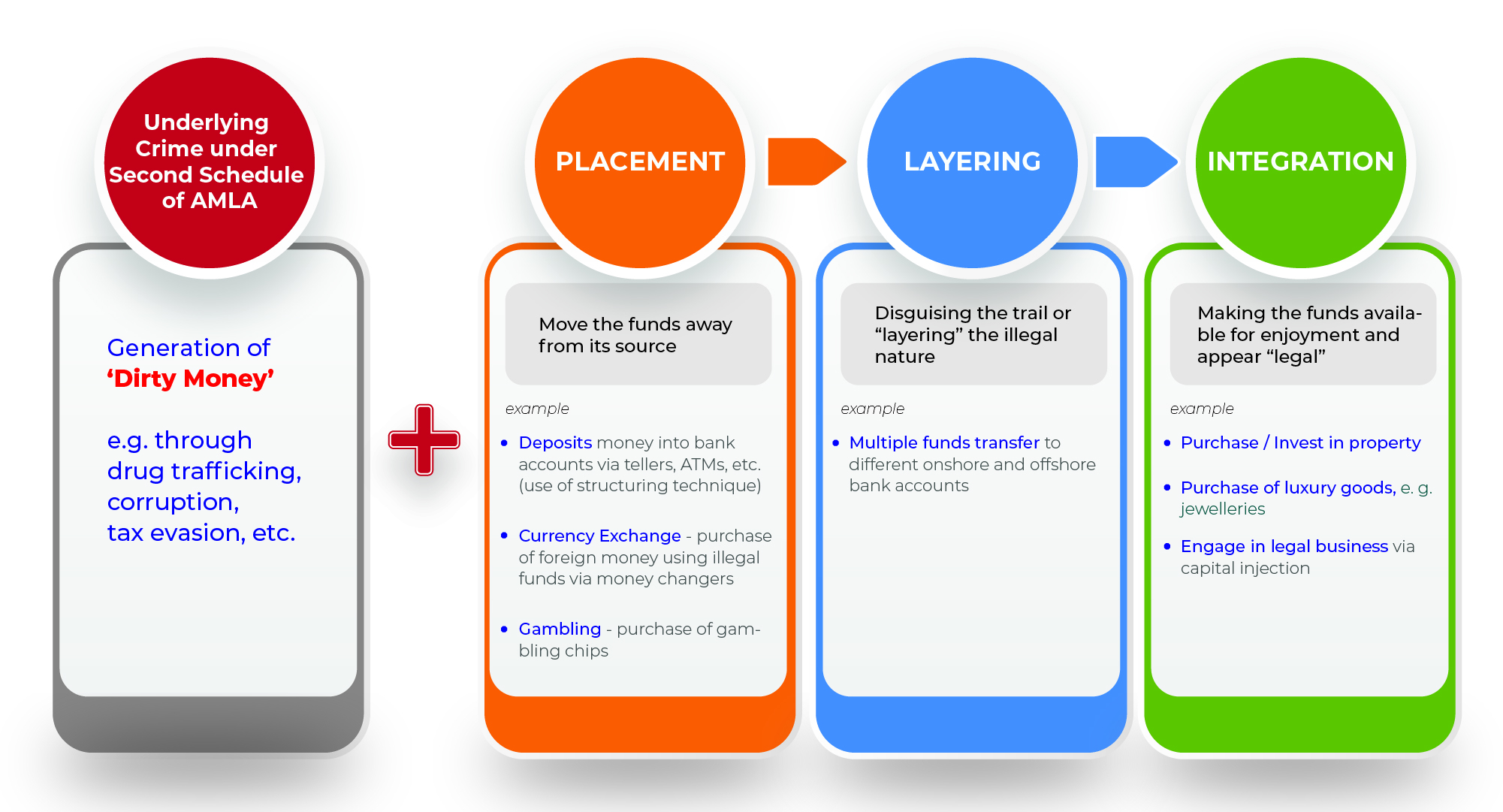
Placement
Illicit funds are separated from their illegal source. This typically happens when illegal funds are placed into a reporting institution.
Layering
Creating multiple layers of transactions to distance or disguise the illegal funds from their illegal sources. This is to obscure or make it difficult to trace the origin of the illegal funds. This may involve multiple transfers between accounts, hiding funds in shell companies or trusts or transferring funds into multiple assets.
Integration
Final stage where the laundered proceeds are successfully integrated into the economy appearing as legitimate funds. This may include purchases of properties or high value goods, and investment into business ventures.
Money launderers tend to seek out reporting institutions with weak anti-money laundering controls to ‘clean’ the illegitimate funds through theses multiple stages, since there is less risk of detection.
What is anti-money laundering and countering financing of terrorism (AML/CFT)?
AML/CFT refers to any measures to prevent or combat money laundering and terrorism financing. For a country, this may include the laws and regulations that are enacted to prevent criminals from laundering/financing terrorism or, when they launder/ finance terrorism, to prosecute them in court.
For reporting institutions, AML/CFT measures may refer to systems or programmes, or known as AML/CFT Compliance Programme, designed to assist the institutions in preventing themselves from being misused by criminals seeking to launder money through their businesses.
An AML/CFT Compliance programme will cover many areas that help prevent and detect such abuse. The AML/CFT Compliance Programme will enable reporting institutions to report potential money laundering or terrorism financing activities to authorities. Collectively, these measures are called ‘preventive measures’ and the institutions which are designated by law to conduct these measures are called ‘reporting institutions’.
ML Case Study
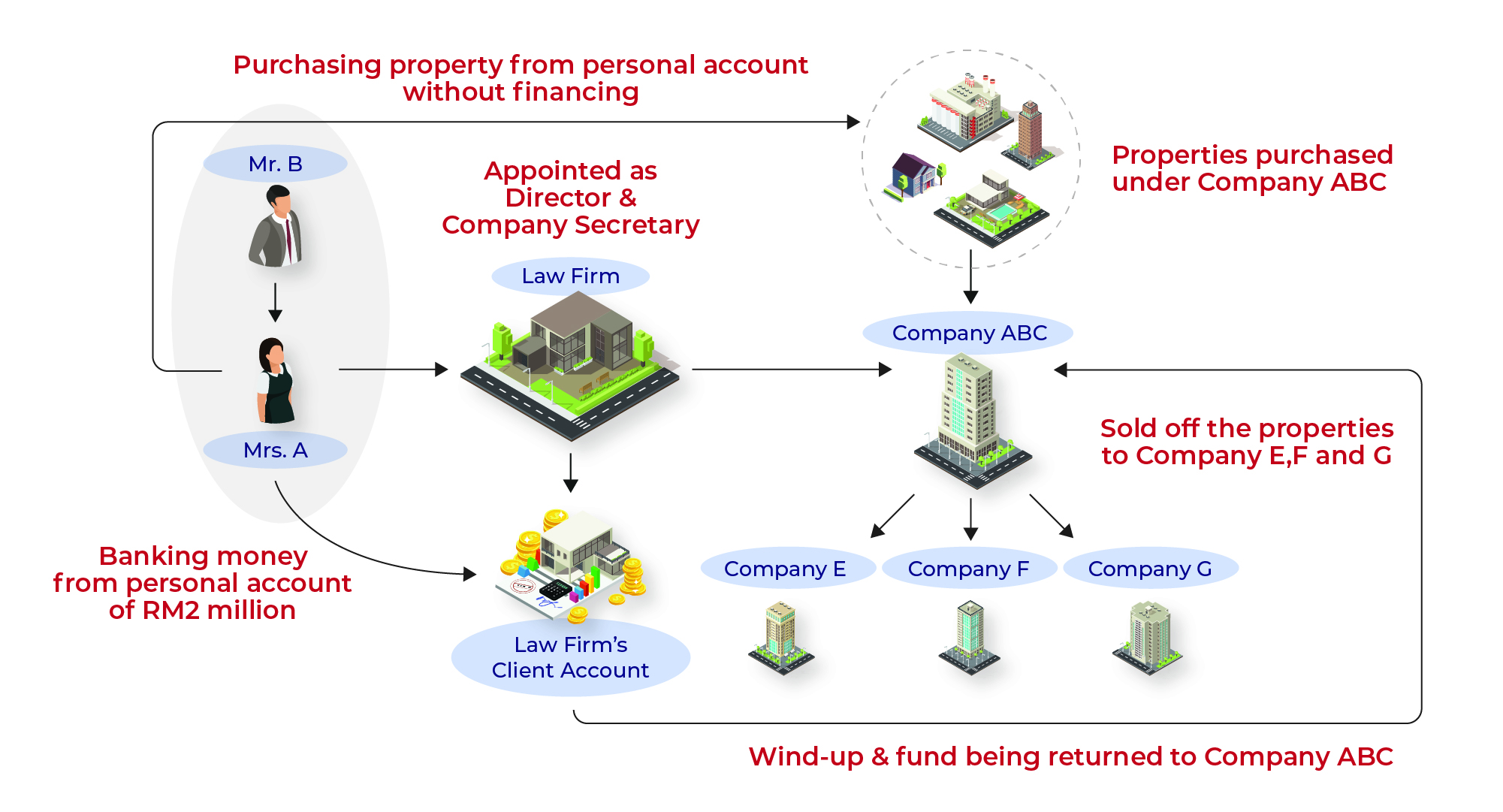
Case 1: This is a case of a lawyer operating in a small law firm and how a client was able to abuse the lawyer’s services and client account for money laundering.
Mr. B is a long-standing customer of the law firm, refers a friend, Ms. A, a foreigner who just entered the property business in Malaysia. Ms. A needed a lawyer to advise her while also being the director and company secretary to her newly-formed company, Company ABC.
A few days later, Ms. A transferred RM2 million into the firm’s client account and called the lawyer to inform that the money was for the fees for the work they will need the firm to do in the next few months. Ms. A also said they have not opened a bank account but plans to do so later.
Over the course of 2 months, Ms. A made 16 property purchases in the secondary market using her personal funds, without any financing from banks. The sale and purchase agreement, however, was made on Company ABC’s name and not her own. The properties were located in run down parts of Kuala Lumpur and some were in bad shape. All the properties amounted to RM2.8 million. Later on, she immediately sold off the properties at a significantly higher price of RM8.5 million despite making no renovations on any of the properties, to the lawyer’s knowledge. These purchases also did not involve financing.
10 properties were sold to Company E for RM6.0 million
5 properties were sold to Company F for RM2.0 million
1 property was sold to Company G for RM0.5 million
In consolidating the payment, an account clerk at the law firm found that some of the payments were made through cash deposit machines from multiple states and that certain bank transfers were from individuals or companies who have no clear relationship with Companies E, F or G. The clerk grew suspicious and discussed the matter with the Compliance Officer (CO). The CO was unsure of what to do and left the situation unattended.
The sale and purchase of all 16 properties were completed and the proceeds from the sales were transferred to Company ABC’s newly opened bank account after deducting the lawyers’ fees. Despite the successful sale of the properties, one month later, Ms. A informed that they are closing down their operations in Malaysia and instructed the lawyer to wind up the company. She requested for the excess payment from the initial RM2 million minus whatever fees to be transferred to a foreign company, which she says is her main company.
A few months later, news broke that Ms. A has been charged with money laundering of drug proceeds in her home country.
What are the red flags in this case?
- Substantial upfront payment to the firm for future work
- The speed at which the transactions were done (bought and quickly sold)
- The sale of goods at a premium or inflated price
- Cash payment made into lawyer’s client account from multiple locations
- Involvement of multiple third parties without a clear reason / relationship
What risk is the reporting institution facing in this situation?
- Criminals abusing the lawyer’s clients account as a place to ‘park’ their illegal money
- The firm may be unknowingly facilitating transfer of illegal money from one party to another
- Reputational risks to the firm
- Regulatory or criminal sanctions for not properly conducting customer due diligence (CDD) and not submitting a suspicious transaction report (STR)
What should have been done in this situation?
- Conduct CDD and risk assessment before engaging with a customer.
- Establish a list of red flags and share with the firm’s staff to help them to identify potentially suspicious transactions.
- Formulate policies to guide staff on how to report any suspicious transactions they may encounter.
- Appoint a compliance officer with the appropriate skills, knowledge and experience.
- CO needs to assess whether STR need to be submitted to Bank Negara Malaysia (BNM).
Click here to download the Case Study
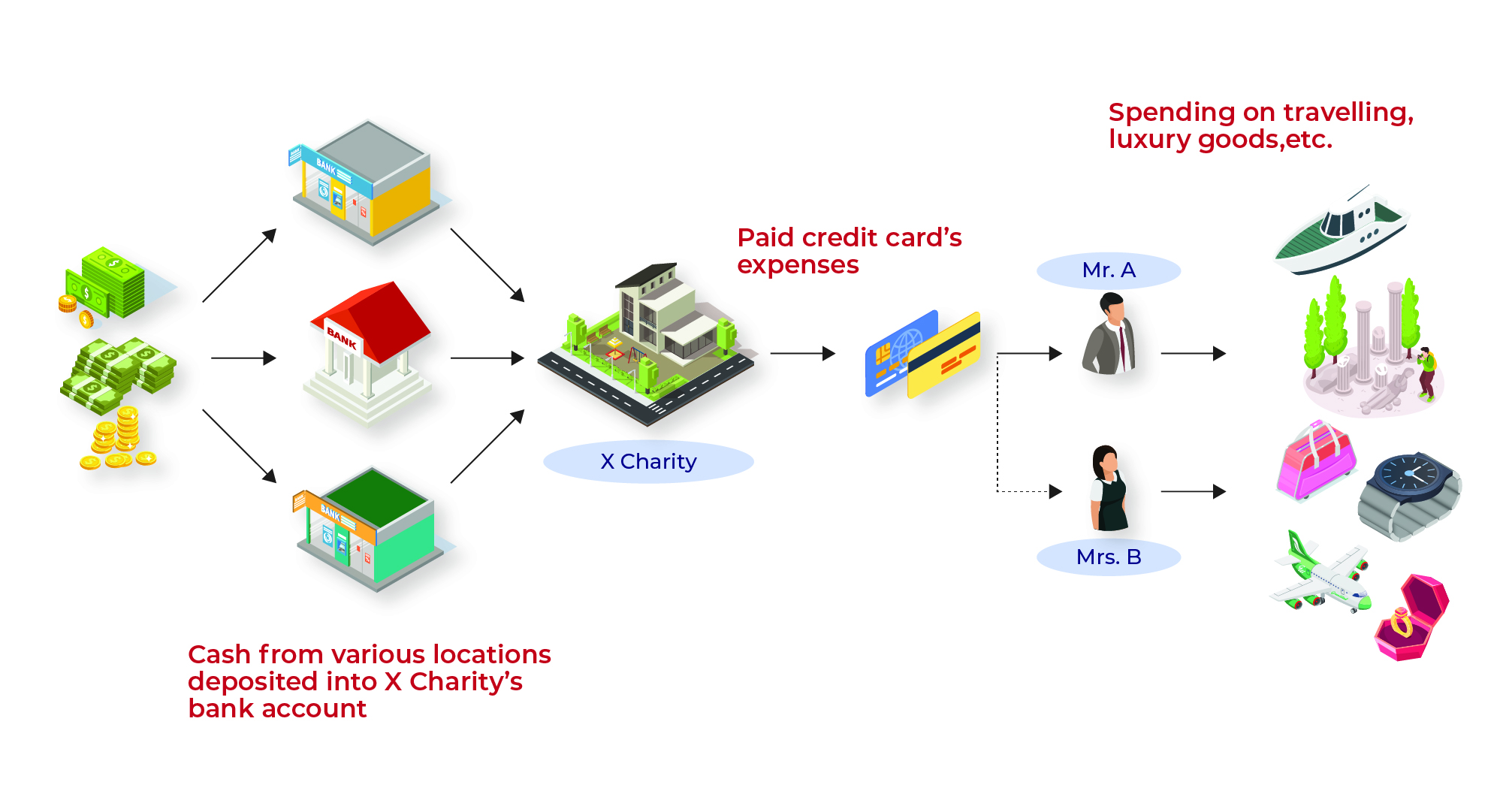
Case 2: This is a case of banks that were abused by a criminal to launder illegal proceeds.
Mr. A is a high-ranking government official who is also Chairman for X Charity. X Charity maintains a current account at a local bank, with Mr. A as the sole signatory. His wife, Mrs. B is housewife and hold a few credit cards under her husband’s accounts. The cards were actively used for travelling, purchasing luxury goods and staying at expensive hotels overseas.
Mr. C is a newly appointed compliance officer who is well experienced in anti-money laundering and countering financing of terrorism (AML/CFT). Mr. C took over the position that has been vacant for quite some time. While reviewing transaction reports from his officers, he noticed irregularities as follows:
- Mr. A’s credit cards were paid by X Charity;
- frequent cash deposits from various locations below the value of cash threshold reporting requirements from X Charity’s bank account; and
- multiple large cheques deposited into the account from various entities without reasonable justification.
Before Mr. C completed his assessment, he received Orders from law enforcement agencies to produce X Charity’s statement of account. Mr. A was subsequently charged with multiple counts of criminal breach of trust, money laundering and abuse of power.
What are the red flags in this case?
- Single signatory for X Charity
- Payment of credit card by a charity organisation
- Frequent cash deposits from various locations
- Large cheques deposited from various entities
- Spending behavior does not commensurate with the income
What risk is the reporting institution facing in this situation?
- Criminal abusing the bank to penetrate illegal proceeds into the financial system
- Reputational risks to the bank
- Fines for not implementing adequate AML/CFT Compliance Programme including failure to submit STR.
What should have been done in this situation?
- Put in place effective compliance programme.
- Appoint a compliance officer who has knowledge and expertise in AML/CFT
- Establish red flags and ensure trainings are provided to relevant employees.
Click here to download the Case Study